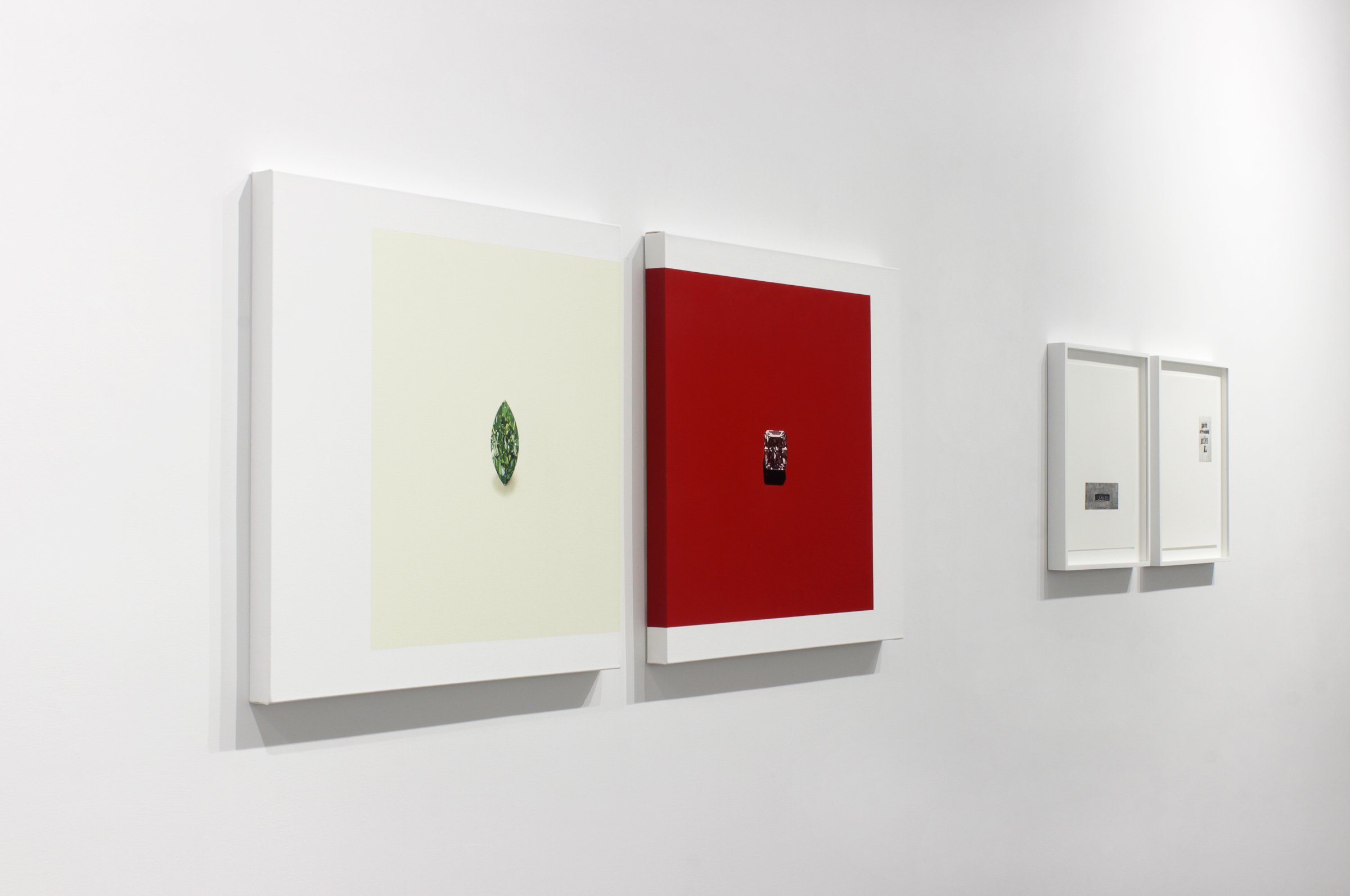
Dialectics of Memory: Object/Subject/Painting (2014–25)
Over the last decade, I have developed an ongoing series of paintings that examine value, desire, and the civilizing processes embedded in objects sold through auction catalogs. I focus on timepieces, fine silver, firearms, wooden furniture, and extraordinary gems and jewelry— items that embody both craftsmanship and cultural aspiration. Painted in meticulous photorealist detail, these works mirror the precision of the originals, preserving their aura of permanence and refinement.
Each painting is titled after the auction lot number and its catalog description. This includes, in order, the lot number; the object’s name and type (a spoon, a ring, a chair, a timepiece); the name of its maker or artisan; the date of creation; its weight (if silver, gold, or platinum); its carat (if a gemstone or diamond); its type of wood; and a highly specific yet condensed description of its features, such as notes on craftsmanship, condition (scratches and blemishes), provenance, and the starting bid. The title concludes with the name of the auction house, the date of sale, and the traceable sale code assigned to the lot.
I use this catalog text as material because it speaks in a specialized form of language—at once technical, promotional, and seductive—that has become second nature in the art world. It is a constructed discourse, one that reveals how value and desire are inscribed into objects through language. In this sense, the title itself becomes material, a linguistic surface as charged as the painted one. Inspired in part by Robert Smithson’s “heaps of language,” I approach these titles as another layer of facture, where words are treated as matter. At the same time, they expose the fetish character of commodities, as Freud and Marx both noted: objects endowed with exaggerated significance that both reveals and conceals the unconscious desires invested in them.
This project builds on the legacy of still life and the Dutch Golden Age, where depictions of flowers, vessels, and luxury objects celebrated wealth while also moralizing on the transience of life. Yet in the contemporary auction house, these commodities do not symbolize vanitas or mortality but rather serve as engines of value creation. They are not consumed but recirculated, their worth augmented through the spectacle of bidding. The auction functions as a machine of memory: instead of mourning loss, it inflates worth, converting use-value into exchange-value and enshrining ownership itself as the highest form of permanence.
Like my portrait series, these works are also about memory. They depict objects that have long outlived their owners, carrying traces of private histories into the marketplace. Yet unlike the fragile survival of forgotten individuals, these commodities are preserved, celebrated, and continually revalued. Their endurance is tied not to affective remembrance but to financial speculation and institutional stewardship.
I see these paintings as counter-narratives to my portrait cycle. If the resistance portraits grapple with erasure, repression, and historical silence, the auction series engages with sumptuous desire, ownership, and the ethics of preservation. Together, they map two opposing memory structures: one that risks disappearance, the other that guarantees circulation.