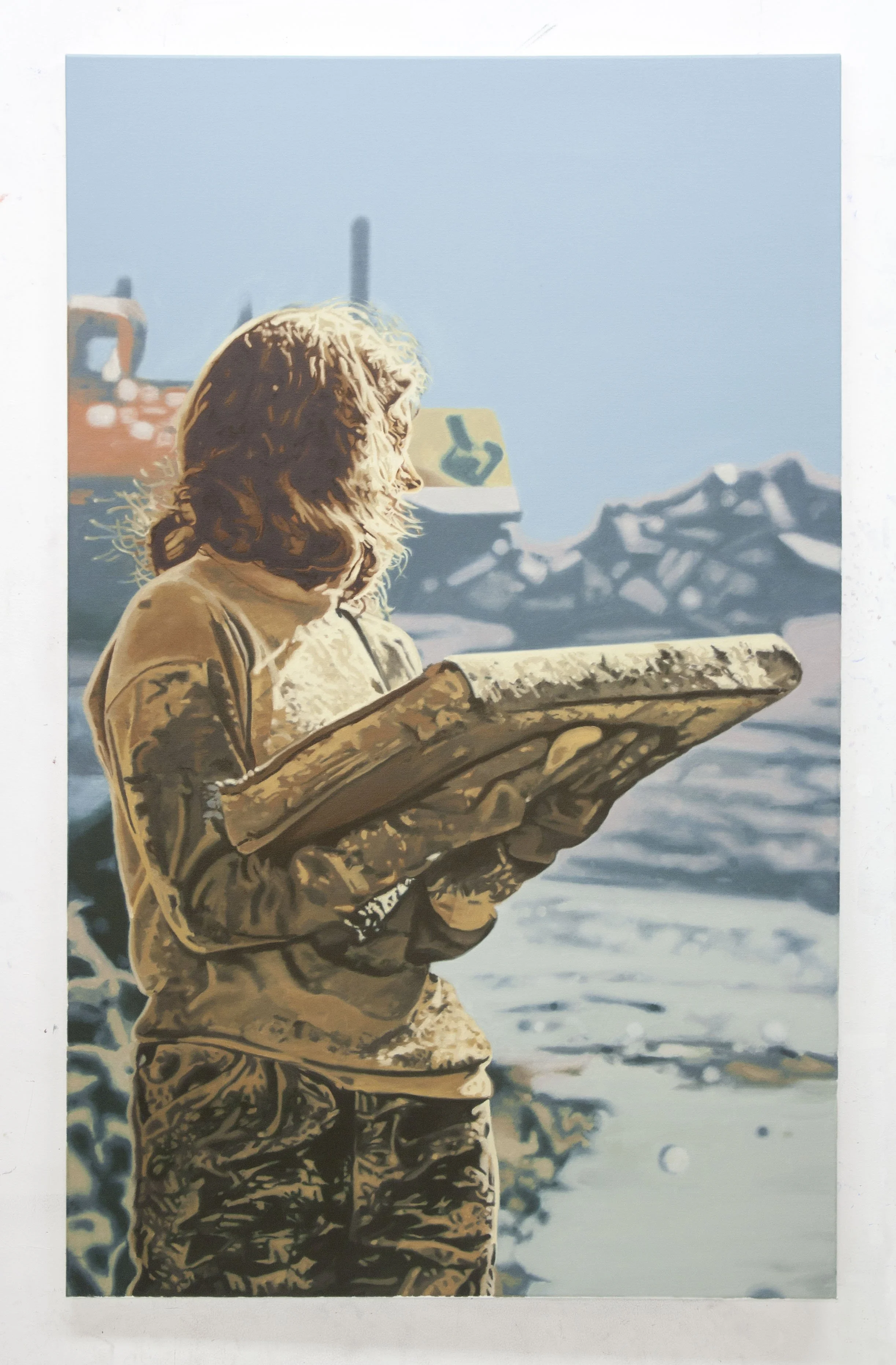
Rescued Manuscript, Kodachrome, 48” x 30”, oil on canvas.
The Endurance of Memory (2003-25)
My practice is grounded in the politics of memory and the forces of erasure that shape history, culture, and perception. Through painting, writing, sound, and bookmaking, I engage archives, artifacts, and images that risk being forgotten or overwritten—whether by state repression, ideological control, or the relentless churn of the present. Each project begins with a fragment—an object, a photograph, a story—and unfolds into a meditation on value, survival, and representation. Across these forms, I seek not to restore what has been lost, but to create reparative gestures: counter-archives and visual structures that insist on remembrance, resist disappearance, and make visible the persistence of memory.
Across projects, I return to the same questions: How does memory survive erasure? How do images both preserve and distort? How is value constructed and circulated, and how might art resist the violence of forgetting?
The current project, Book Out Of Stock But Six Pictures, centers on Mildred Fish Harnack and other overlooked women of the anti-Nazi resistance. Their stories were not only violently cut short by fascism but later erased or distorted during the Cold War. By working with archival fragments—photographs, letters, traces of lives hidden or destroyed—I aim to construct counter-archives: objects and images that resist disappearance and insist on remembrance. In an era of 24/7 news cycles and algorithmic feeds, where narratives are continually refreshed, overwritten, and forgotten, these paintings insist on slow memory. Their surfaces—layered, effaced, repaired—embody the tension between remembering and forgetting, fragility and persistence.
This reparative impulse extends across my practice. If the resistance portraits confront historical erasure, another body of work investigates the endurance of objects within systems of circulation—Object/Subject/ Paintings. Over the past decade, I have painted objects (commodities) drawn from auction catalogs: timepieces, fine silver, firearms, wooden furniture, extraordinary gems and jewelry. Rendered in meticulous photorealist detail, these works mirror the precision of the originals, embodying permanence and refinement. Unlike fragile human lives, these commodities are preserved, celebrated, and endlessly revalued. Auctions themselves function as machines of memory—not mourning loss, but inflating worth, converting use-value into exchange-value. In this way, these paintings form a counterpoint to the portraits: two opposing memory structures, one at risk of disappearance, the other guaranteed circulation. One, a meditation on the price of memory, the other, its pricelessness.
A third strand of my work examines how memory is inscribed in surface and time. My paintings of red and blue velvet folds hover between representation and abstraction: they resemble both satellite images of the earth and close-up photographs of fabric used in auction catalog staging. For me, these are “time-images,” inspired by Henri Bergson’s Matter and Memory and Gilles Deleuze’s writings on duration and the fold. They register instants of movement and suspension, materializing time as surface in flux. The cinematic resonance of David Lynch’s Blue Velvet—with its vision of violence concealed beneath beauty—adds another layer, staging velvet as a metaphor for capitalist society: sumptuous on its surface, concealing darker undercurrents.
Questions of vision, value, and erasure also extend to the planetary scale. Condition Report: Deregulation drew on LANDSAT satellite photographs published by NASA in the 1970s. Depicting Antarctica, the Amazon, and desert aquifers, these images reveal how technologies of vision designed for scientific knowledge also serve as instruments of surveillance and extraction. Painted in primary colors keyed to the heat-sensor imaging system, the works map sites of fragility, abundance, and scarcity at a moment when neoliberal deregulation was accelerating the plunder of global resources.
This concern with landscape and resource extraction deepened in Storytelling. Here, I examined how picturesque images of the American West both idealized nature and obscured the violent seizure of mineral wealth— gold, silver, uranium ore—from Indigenous lands. By juxtaposing color charts derived from landscape palettes with collaged “ribbons” made from geological survey maps and metallic vellum, I created clues to the hidden materials beneath the surface. Displayed alongside outmoded encyclopedias and magazines like National Geographic and Reader’s Digest, the works underscored how media propagated myths of manifest destiny while concealing extraction and dispossession.
The impulse to interrogate archives and knowledge systems first emerged in Memorabilia, an early project in which I deconstructed abandoned encyclopedias, reclassifying pages into typologies (“Mountains,” “Flowers,” “Creatures,” “Architecture”) and translating them into paintings and drawings. Indexed and categorized within a new alphanumeric system, the project reflected on the fragility of archives in the early 2000s, when digital platforms like Wikipedia were displacing printed reference books. Informed partly by Michel Foucault’s Archaeology of Knowledge, the work anticipated today’s anxieties about the disappearance and manipulation of both physical and digital records.
Questions of value, reproduction, and spectacle came to the fore in Negotiations (2011) and $72 Million Sale Shatters Warhol Record (2012). Negotiations was a word-for-word reproduction of a Christie’s New York antiques catalog from 1983, layered with magnified halftone fragments, glossaries, and essays that transformed the catalog into both artifact and discursive system. $72 Million Sale Shatters Warhol Record extended this interrogation to the art market’s spectacular dimension: how headlines, price records, and the circulation of value themselves become memory-events, eclipsing the artworks they reference. Taken together, these projects probe how markets construct, abstract, and mythologize value, producing their own forms of historical memory.