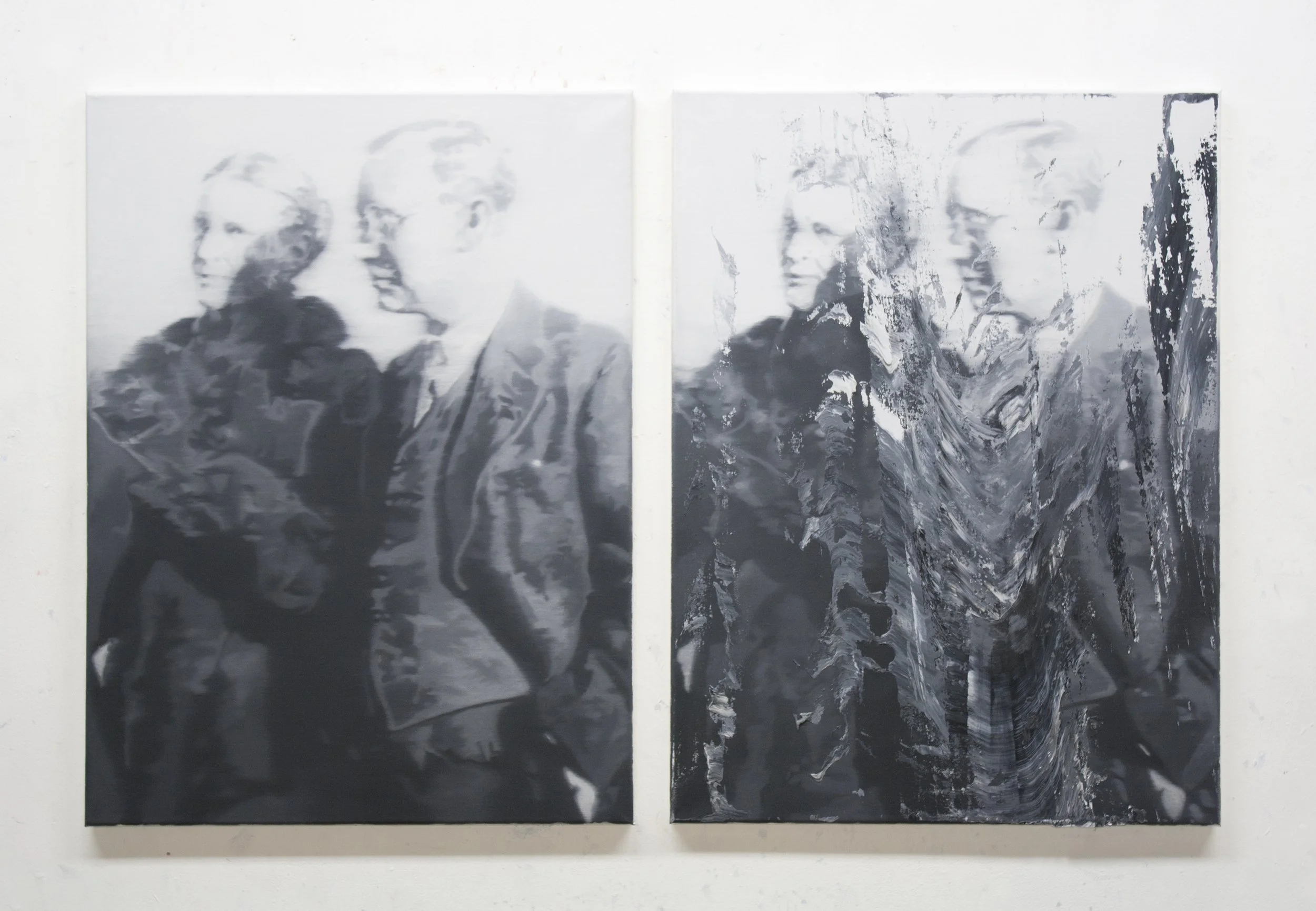
Together Again, oil on canvas, diptych, 18” x 24”, each, 2023
Book Out of Stock But Six Pictures
Book Out of Stock But Six Pictures is a cycle of paintings about the American Mildred Fish Harnack, whose life and death were entangled with the traumatic events of the twentieth century: the atrocities of Nazi Germany, Soviet espionage, and the anti-communist climate of McCarthyism in the United States.
Mildred Harnack endured two deaths. First, her physical death by guillotine in 1943, executed by the Nazis for her role in the resistance movement known as the Rote Kapelle (Red Orchestra). Second, her symbolic death—what might be called a mnemonic annihilation—at the hands of the U.S. government. Because of her ties to communism, she was cast as an enemy of the state, and her story was suppressed, her contributions erased from public memory, her intelligence work buried in classified files.
Harnack also engaged in acts of self-erasure. Secrecy was essential for survival as an active opponent of the Nazi regime. Out of fear, her siblings destroyed many of her letters and photographs. Without the foresight and devotion of her mother—who preserved a hidden archive of photos, letters, ephemera, and even a lock of Mildred’s hair—her memory might have disappeared entirely. Decades later, those fragments resurfaced, revealing the remarkable story of a woman whose courage placed her at the heart of the German resistance.
Memory Image
My work approaches painting as a site where memory and history converge. I often begin not from emptiness but from an inherited image—already carrying the weight of history, the ambiguity of recollection.
One of the techniques I’ve developed builds on the tradition of grisaille photo-painting associated with the German painter Gerhard Richter, who also lived through the events of the Third Reich and the postwar politics of East and West Germany. This monochromatic approach, in which brushwork is blended away and gesture suppressed, produces a blurred image that hovers between photograph and painting, presence and disappearance.
From there, I subject the surface to a process of repetition and transformation—painting over, effacing, sanding, scratching, smearing. Each action creates a tension between erasure and renewal. The image shifts unpredictably, becoming unstable, provisional, resistant to closure.
In this way, the work turns away from the authority of fixed representation and toward the fragile persistence of memory itself: its disintegration and recovery, and its uneasy coexistence of clarity and obscurity.
Liquid Image
Through the interplay of realist technique and abstraction—what might be called both skilled and deskilled painting—I aim to create images that feel unstable, enigmatic, and provisional. Each painting registers the trace of events left in the wake of material processes, what I think of as a memory-image. Some works appear as if the image were peeling away, others resemble torn screens or fractured surfaces. Still others evoke a “liquid image,” where the very materiality of paint—its fluid density, its suspension in layers—produces visual echoes of the chemical processes of analog photography and film development. In this way, the paintings resist closure. They inhabit a space where material substance and historical reference intermingle, where memory itself is figured as mutable: dissolving, reforming, and slipping into new configurations of meaning.
Repair
Painting, at its core, is an art of memory. Each layer, each gesture, carries the potential to recall, to conceal, or to transform what came before. In this sense, painting itself becomes a form of memory-work—an active process of revisiting, revising, and reinterpreting.
Like Freudian dream-work, memory-work operates through displacement and return, moving back and forth between manifest content and latent meaning. This pendular process uncovers not only what is consciously remembered but also what has been repressed, silenced, or forgotten. Through repetition and transformation, memory reemerges in altered form—revealing displaced truths about ourselves and our societies.
For me, this process is not about redemption but reparation. Redemption implies a final resolution, a cleansing or transcendence of trauma. Reparation, by contrast, recognizes what has been broken and attempts a form of repair—without denying the wound, without promising closure. My paintings take up this reparative task: they work through traces of history and memory, not to erase them, but to insist on their persistence.
In this way, painting serves as both confrontation and care: a means of engaging historical trauma and symbolic loss, while keeping visible the fractures and absences that cannot be redeemed.
Kassiber
The title Book Out of Stock But Six Pictures comes from a “Kassiber,” a coded message used by members of the resistance to communicate with others in the network. These clandestine notes were often smuggled in the hems of laundered clothing, passed in and out of detention centers, and circulated among underground cells.
One such Kassiber was sent after the trial of Arvid and Mildred Harnack. It read: “Book out of stock,” signaling a death sentence by hanging for Arvid, and “But six pictures,” indicating a six-year labor camp sentence for Mildred. When this message reached the resistance, Adolf Hitler, enraged by what he saw as undue leniency, ordered a retrial. Mildred was then condemned to death by beheading.
I take this phrase as the title of my project because it crystallizes so many of the issues that shape my work: language under duress, memory encrypted and hidden, the fragile survival of meaning under conditions of violence and censorship. A Kassiber was both a lifeline and a fragment, its survival dependent on secrecy and chance. Likewise, these paintings hold memory in precarious form, carrying forward stories that might otherwise remain silenced or erased.