The Chandelier: 72 Million Shatters Warhol Record (2012)
The title of this project is taken from a New York Times article that triumphantly reported “record-breaking” prices realized during an auction in May 2007, on the eve of the global financial crisis. The auction realized $384.65 million, and the article concluded with the line: “Contemporary art, as fragile as it often seems, is in for a long haul.” The tone of the piece captured the hubris of the period, asserting the art market’s immunity to the looming collapse of global credit markets. In fact, the market’s sharp decline followed shortly thereafter.
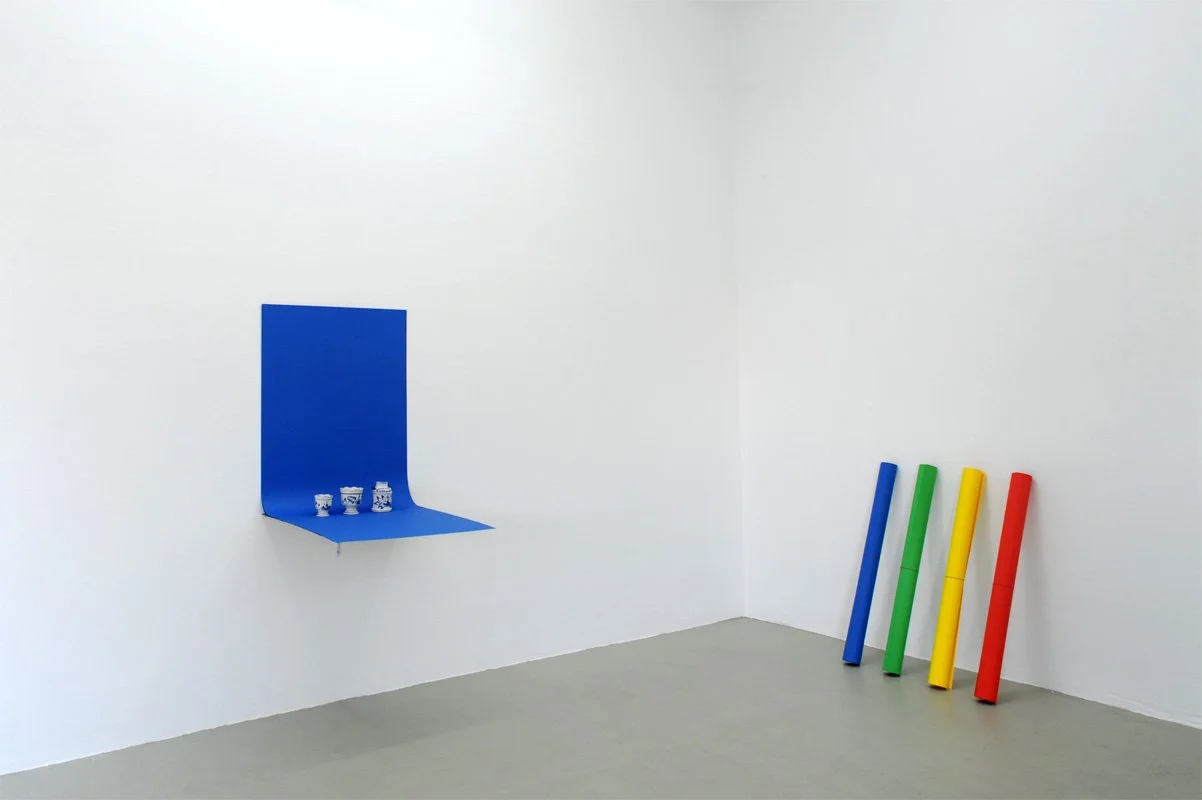
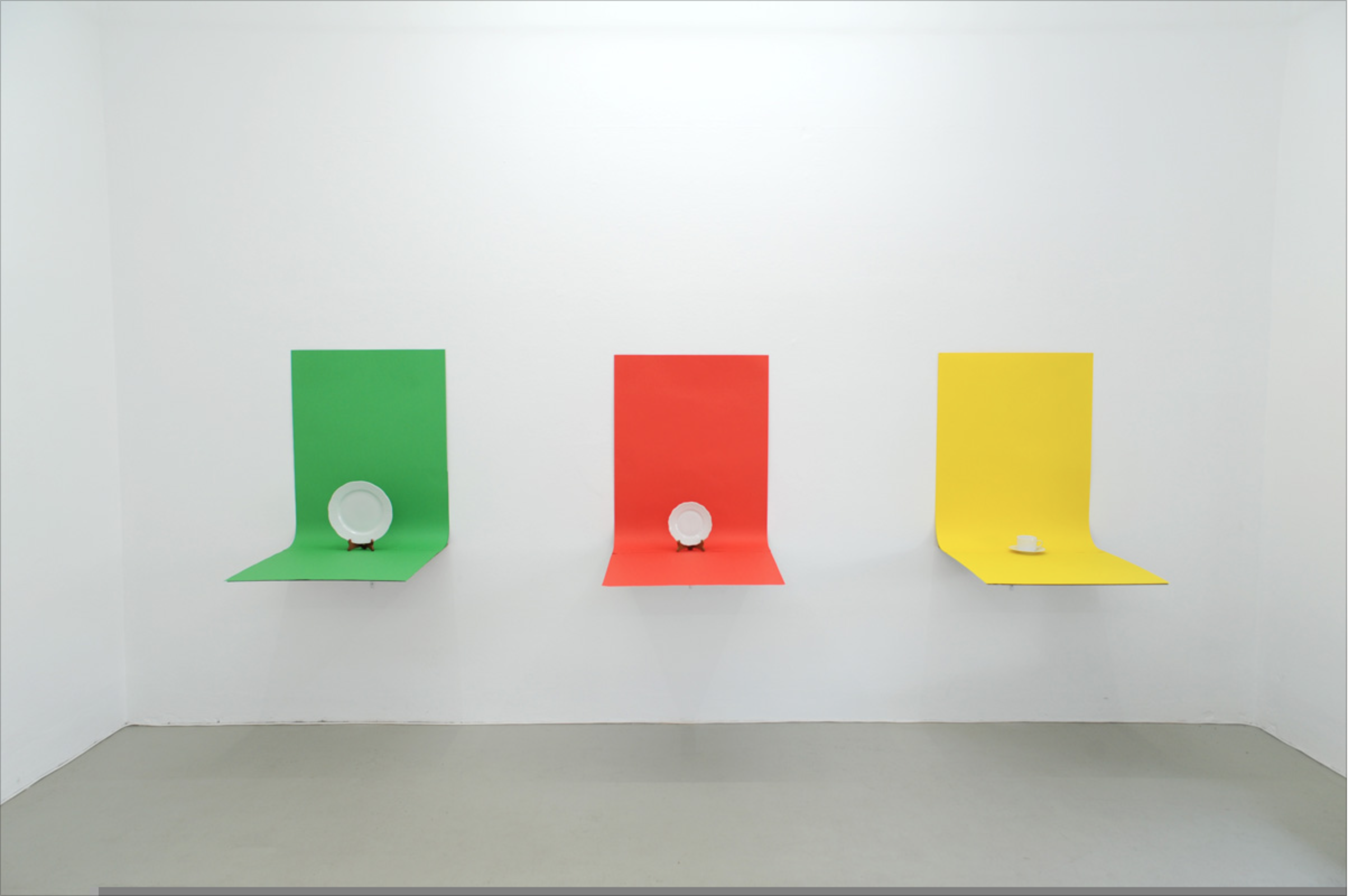
The article was appropriated as a “press release” for the exhibition and served as a structural device linking works cited in the text to specific installations in the gallery. Each artwork referenced in the article corresponded to a fabricated wall-relief. For example, a series of dinner plates set against a green backdrop was titled Warhol, Green Car Crash (Green Burning Car) [71.7M], while a composition of wine glasses on a black backdrop was titled Richter, Abstract Composition [6.2M].
The wall-reliefs themselves were re-fabricated simulations of a photographer’s studio, the kind used to produce images for antiquarian auction catalogs. Rolls of excess backdrop paper leaning against the gallery walls were labeled “production values,” signifying the extra colors deployed to generate varying photographic compositions in the accumulation of “surplus-value.”
At the center of the exhibition was GINSBURG-5412, the first in an ongoing series critically examining photographic reproductions from auction catalogs. Modeled on the same conceptual procedure as an earlier work, MEYAR-6932, this iteration focused on the reproduction of an antique chandelier. The project was presented as a “folio” of prints and texts, sealed in white envelopes and displayed on a pedestal in the gallery.
Each envelope contained a supplementary text with technical definitions of the terms bid and lot. Embedded in the definition of bid was the practice of “chandelier bidding”—also known as phantom bidding—in which an auctioneer places fictitious bids in the absence of a bona fide bidder. While only illegal if the final sale price fails to exceed the phantom bids, the practice is neverthelessa form of price-fixing and psychological manipulation. As Amy Cappellazzo, former head of postwar and contemporary art at Christie’s, once described, such bidding was “exciting” and a way of “activating” the energies of an audience.
Through this project, I sought to establish a critical grammar for understanding how the logic and ideology of finance capital infiltrates the social field of art. The installation examined not only the spectacle of auctions and their manipulative strategies but also the wider economies in which cultural production is enmeshed. Today, galleries operate as multinational corporations (Gagosian, Pace, Christie’s, Sotheby’s), while some artists’ studios resemble high-output factories (Damien Hirst, Jeff Koons, Takashi Murakami). At the same time, mega-collectors—industrialists such as Victor Pinchuk, François Pinault, and Roman Abramovich—have come to dominate and, in some sense, monopolize the exhibition system itself. This dynamic mirrors our broader social reality, in which oligarchic wealth and the entrenchment of autocratic regimes are increasingly normalized, shaping not only markets but also the political and cultural conditions under which art is produced, circulated, and remembered.